


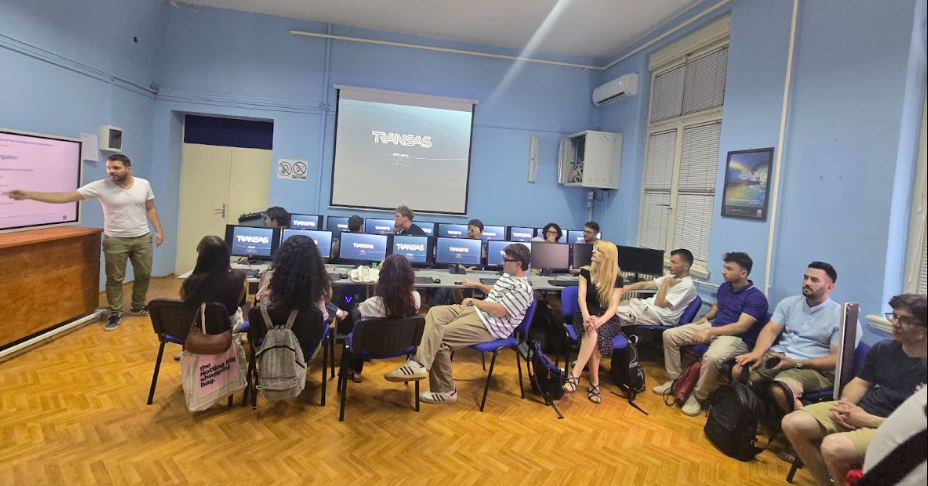
On Thursday, July 2, the International Summer School “Sustainable Development of the Yachting and Cruise Industry” continued at the Faculty of Maritime Studies, University of Montenegro, with lectures delivered by Capt. Ivan Mraković.
Organised within the Interreg IPA South Adriatic project “High LEVEL and market-respondent competences for a blue and digitalized ‘Smart and skilled South Adriatic’ - SKILLS”, the sessions focused on two highly relevant thematic areas for the future of maritime tourism and the Blue Economy: safe navigation and digital transformation of marinas and cruising ports.
Within Thematic Module 5 – Assessment of Main Navigational Parameters, participants were introduced to the principles of safe maritime navigation and the key systems used in modern ship operations. The module covered the importance of international conventions and regulations, including SOLAS, COLREG, STCW and relevant national rules, with particular attention to their application in complex and busy maritime environments such as the Bay of Kotor.
Capt. Mraković presented the role of RADAR, Automatic Radar Plotting Aid and Electronic Chart Display and Information System technologies in improving situational awareness, route planning, vessel positioning, collision avoidance and navigational risk assessment. Participants discussed how these tools support safer navigation, more efficient voyage planning and better environmental performance.
The module also addressed practical navigation challenges in the Bay of Kotor, including high traffic density, narrow navigable areas and interaction between commercial and recreational vessels. Through case-study examples and simulator-oriented learning, participants strengthened their understanding of how technology, regulations and human decision-making must work together to ensure maritime safety.
The programme then continued with Thematic Module 6 – Smart and Digital Marinas and Cruising Ports, which introduced participants to the digital transformation of maritime tourism infrastructure. The module focused on smart marinas and smart ports, Internet of Things applications, Artificial Intelligence, digital twins, integrated digital platforms, cyber security, data-driven decision-making and environmental monitoring.
Participants learned how digital tools can improve marina and port operations through smart berth management, real-time vessel tracking, visitor management applications, environmental sensors, predictive maintenance, digital booking systems, energy efficiency monitoring and integrated logistics solutions.
Special attention was given to the role of digital technologies in sustainability and marine ecosystem protection. Examples included water quality monitoring, remote sensing, biodiversity monitoring, AI-assisted environmental analysis and early-warning systems for pollution events.
The lectures also highlighted that technology alone does not create a smart marina or port. Successful digital transformation requires secure systems, reliable data, trained personnel, cyber-security awareness and the ability to connect people, vessels, infrastructure and services through integrated platforms.
Through these sessions, the Summer School provided participants with important digital and navigational competencies needed by future professionals in maritime tourism, port management, marina operations and Blue Economy sectors.
By combining maritime safety, smart technologies and sustainability, the SKILLS project continues to support practical, cross-border education and the development of new competencies for a smarter, greener and more sustainable South Adriatic Blue Economy.