


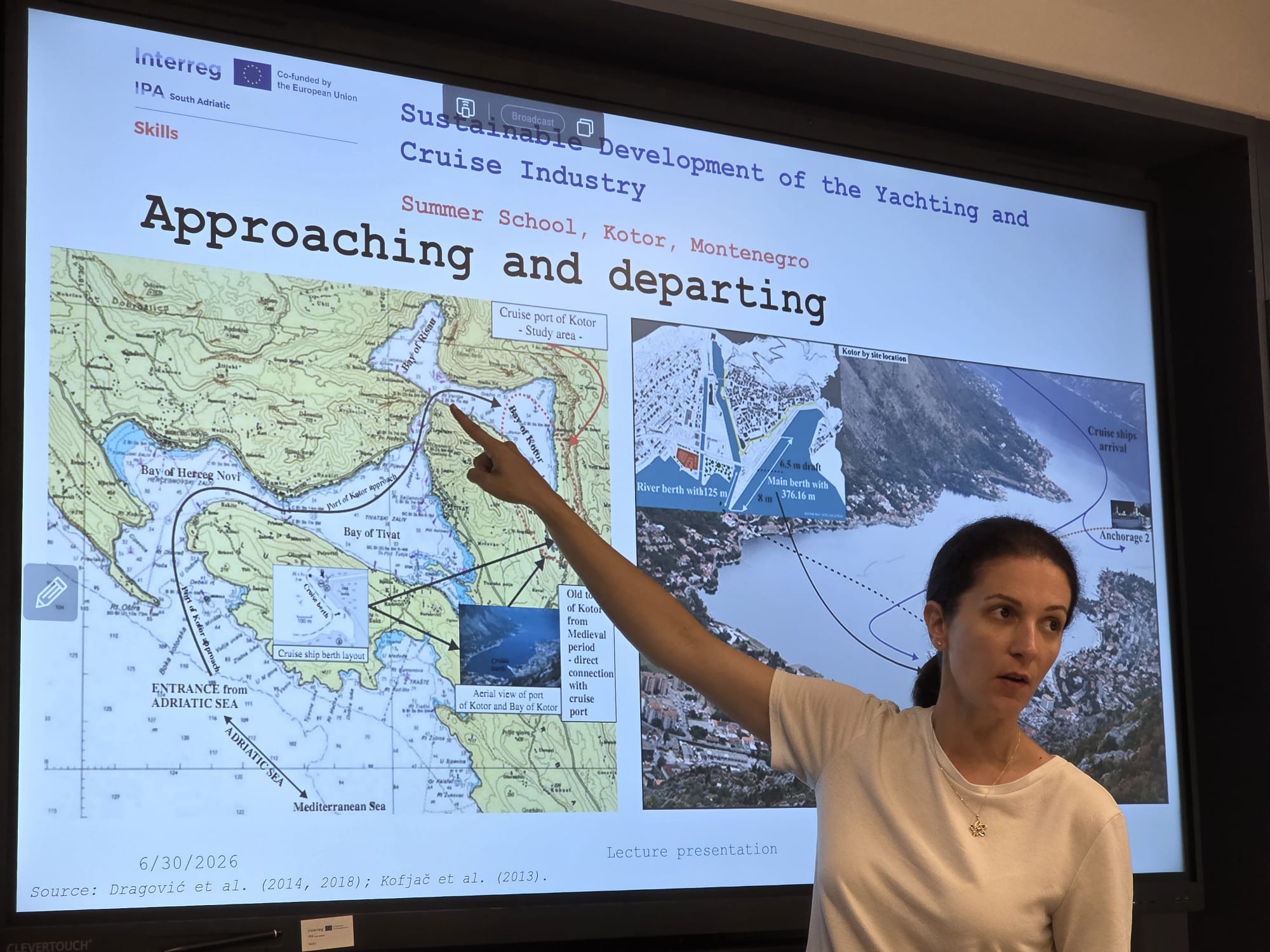
On Tuesday, 30 June 2026, the International Summer School “Sustainable Development of the Yachting and Cruise Industry” continued at the Blue Economy Training Centre of the Institute of Marine Biology, University of Montenegro, with Thematic Module 4: Planning and Development Infrastructure Marina and Cruising Port.
Lesson 4.1, titled “Planning and Development Infrastructure of Marina and Cruising Port”, was delivered by Dr Maja Škurić, Assistant Professor at the Faculty of Maritime Studies Kotor, University of Montenegro.
The lecture introduced participants to the role of ports and marinas in supporting cruise and nautical tourism, with particular attention to infrastructure, services, operational planning, passenger flows, and the specific requirements of cruise ships when approaching ports and marinas.
Participants learned about different types of cruise ports, including home ports, ports of call and hybrid ports, as well as the importance of terminal infrastructure, transport connectivity, passenger services, safety procedures and efficient embarkation and disembarkation processes.
Special attention was given to the configuration of cruise terminals and the organisation of key passenger areas, including entrance spaces, luggage handling, security controls, ticketing, check-in, waiting areas, boarding corridors, staff offices and additional service spaces. The lecture showed how modern cruise terminals must respond to increasing passenger numbers, larger ships, new technologies and higher expectations from cruise operators and passengers.
A central part of the lesson focused on the Port of Kotor as a case study. Participants discussed cruise traffic development, port calls, passenger movements, existing infrastructure, berth capacities, anchorage areas, tendering services and operational policies used for managing cruise ship arrivals and passenger disembarkation.
The session also addressed possible infrastructure development scenarios, including the potential extension of berthing capacity in order to improve operational efficiency and accommodate cruise traffic more effectively, while taking into account the spatial, technical and environmental limitations of the Bay of Kotor.
Through this lesson, participants gained a practical understanding of how cruise port and marina infrastructure planning connects maritime operations, tourism development, passenger safety, destination management and sustainability. The session highlighted the importance of evidence-based planning and operational models for coastal destinations that aim to develop cruise and nautical tourism in a responsible and sustainable way.Maja Skuric 01