


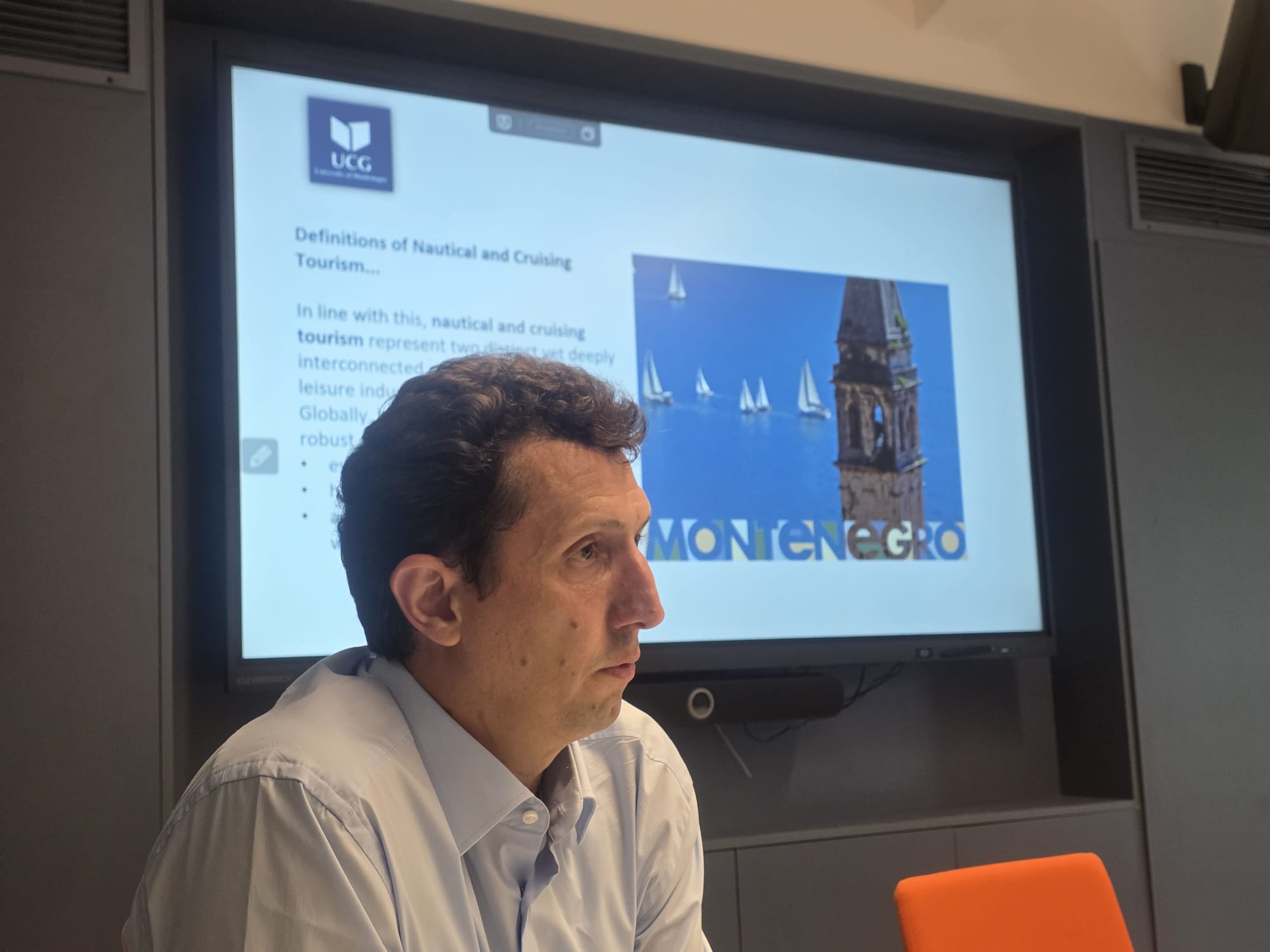
On Monday, 29 June 2026, the International Summer School “Sustainable Development of the Yachting and Cruise Industry” continued at the Blue Economy Training Centre (BETC) of the Institute of Marine Biology, University of Montenegro, with Thematic Module 1: Sustainable Development of Nautical and Cruising Tourism.
Lesson 1.2, titled “Global characteristics of offer and demand in nautical and cruising tourism”, was delivered by Dr Ilija Moric, Assistant Professor at the Faculty for Tourism and Hospitality, University of Montenegro.
The lecture introduced participants to coastal and marine tourism as a broad and dynamic field that includes recreational activities connected with the marine environment and coastal zones. Special attention was given to the development of coastal and marine tourism from traditional beach-based holidays towards more diverse, technologically advanced, and geographically remote tourism experiences.
Dr Moric highlighted technology as one of the key factors shaping the growth of nautical and cruising tourism. New equipment, navigation systems, safety tools, communication devices, water sports technologies, cruise ships, and other innovations have created new opportunities for tourism development and access to marine destinations that were previously difficult to reach.
Participants also discussed the current status of coastal and marine tourism as a global phenomenon influencing developed and less-developed countries, remote and urban destinations, and different forms of tourism, including mass tourism, alternative tourism, ecotourism, and adventure tourism.
The lesson addressed several important future implications for the sector. These included the development of remote coastal destinations, potential conflicts between different recreational activities, competition for coastal space and marine resources, climate change impacts, environmental pressures, visitor safety, artificial marine attractions, special events, and the expansion of commercial mass tourism, particularly in the cruise and resort industries.
The session concluded with discussion questions encouraging participants to reflect on how coastal and marine tourism can be managed in a more sustainable way. Topics included the protection of natural and cultural values, adaptation to climate change, support for coastal communities, reduction of environmental impacts, safety in sea-based activities, restoration of marine habitats, and the consequences of large-scale tourism development.
Through this lesson, the HELM Kotor Summer School strengthened participants’ understanding of the global forces shaping nautical and cruising tourism and opened an important discussion on how future tourism growth can be aligned with sustainability, safety, innovation, and the responsible use of marine and coastal resources.Ilija Moric