


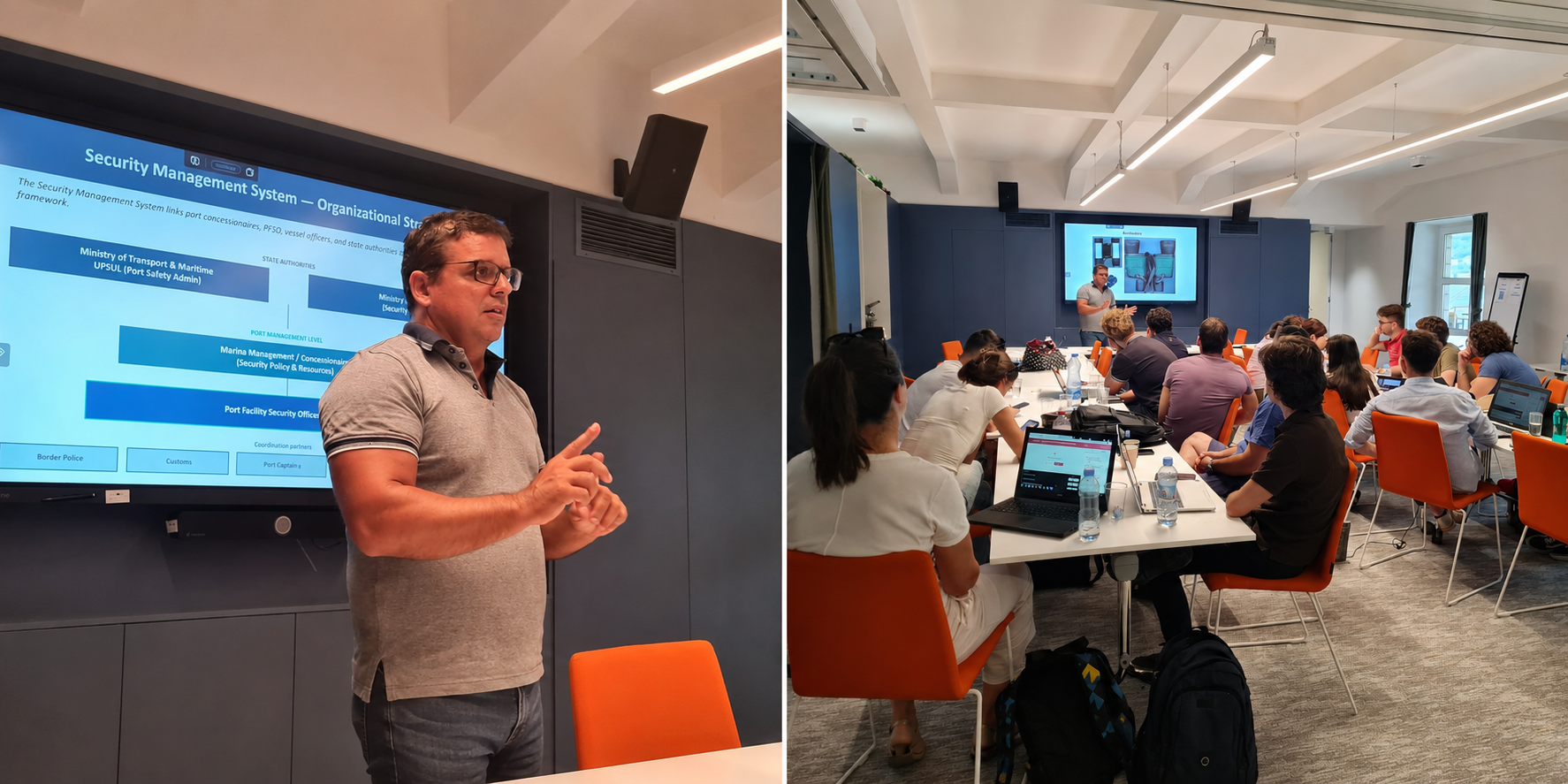
On Wednesday, 1 July 2026, Day 3 of the International Summer School “Sustainable Development of the Yachting and Cruise Industry” continued with a session dedicated to safety and security in marinas and cruising ports, following the practical visit to the cruise ship Marella Explorer 2 anchored in the Bay of Kotor.
Organised within the Interreg IPA South Adriatic project “High LEVEL and market-respondent competences for a blue and digitalized ‘Smart and skilled South Adriatic’ - SKILLS”, the session was delivered as part of Thematic Module 3: Safety and Security in Marinas and Cruising Ports.
Lesson 3.1, titled “Introduction to aspects of safety and security in marinas and ports. International ship and port security code (ISPS code), security protocols, procedures and responsibilities”, was delivered by Dr Miroslav Vukičević from the Faculty of Maritime Studies, University of Montenegro.
The lecture introduced participants to the main security risks, threats and operational challenges faced by marinas and ports, with particular attention to the application of the ISPS Code in marina environments. The session aimed to help participants identify security risks, evaluate the implementation of international standards, recommend preventive measures and procedures, and better understand the importance of collaboration between ports and state authorities.
A key message of the lecture was that security is dynamic rather than static. Participants discussed how challenges evolve together with visitor habits, technology and global threats. The session emphasised that the ISPS Code remains the mandatory foundation for marinas open to international traffic, while cyber security is increasingly becoming a core requirement within modern safety and security management systems.
Special attention was given to the role of people as the most critical security asset. Continuous training, regular drills and security awareness were highlighted as essential elements of an effective safety culture. The importance of cooperation between marinas, port authorities and state institutions was also underlined, especially through structured coordination with border police, customs, maritime safety services and port authorities.
The session also presented the example of day-to-day operations at a luxury yacht marina through a multi-layered security approach. Participants explored practical measures such as 24/7 CCTV and control room monitoring, tiered access control, visitor pre-approval, strict key management, trained and aware staff, and regular maintenance and drills. These measures were presented as the foundation of a secure, private and well-managed marina environment trusted by high-profile clients.
By linking the field experience from Marella Explorer 2 with the classroom session, participants gained a deeper understanding of how safety and security principles are applied across different maritime environments, from cruise ships and ports to marinas. The activity further strengthened the practical, cross-border learning dimension of the Summer School and highlighted security management as an essential competence for the sustainable development of the South Adriatic Blue Economy.
Cover photo: Left: Dr Miroslav Vukićević Right: Summer School lecture room