


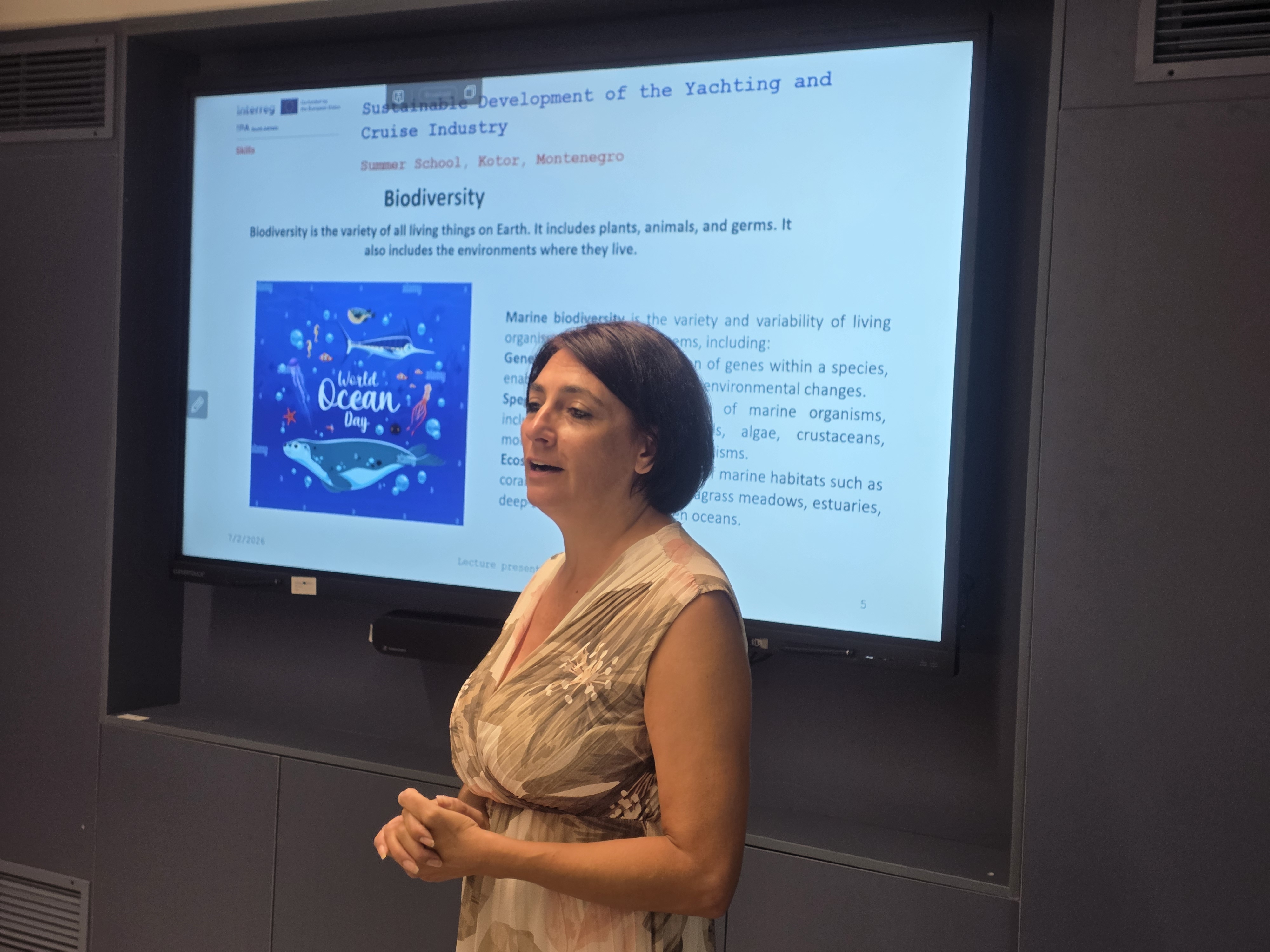
On Thursday, 2 July 2026, the International Summer School “Sustainable Development of the Yachting and Cruise Industry” continued with Thematic Module 7: Green Marinas and Cruising Ports.
Organised within the Interreg IPA South Adriatic project “High LEVEL and market-respondent competences for a blue and digitalized ‘Smart and skilled South Adriatic’ - SKILLS”, the session focused on Lesson 7.1: “Introduction in pollution sea and coast”.
The lecture was delivered by Dr Ana Pešić from the Institute of Marine Biology, University of Montenegro, and introduced participants to the main sources, types and impacts of sea and coastal pollution.
Participants discussed marine pollution as a major challenge for sustainable maritime tourism, yachting, cruise operations and coastal development. The session covered pollution from land-based sources, including municipal waste, wastewater, agricultural runoff and industrial inputs, as well as marine-based sources such as shipping, cruising, recreational boating, aquaculture and fishing.
Special attention was given to pollution from ships, including oil pollution, blackwater and greywater, garbage and solid waste, air emissions, antifouling paints, bilge water, hazardous waste, underwater noise, thermal pollution, accidental spills, marine litter, heavy metals and light pollution.
The lecture also addressed ballast water and hull fouling as important pathways for the transfer of harmful aquatic organisms and non-indigenous species. Participants learned why the Adriatic Sea is particularly sensitive as a semi-enclosed basin and how maritime activities can contribute to ecological pressures if not properly managed.
Dr Pešić presented key international and regional legal frameworks relevant for marine protection, including UNCLOS, the Barcelona Convention, MARPOL, the London Convention, the OPRC Convention and the Ballast Water Management Convention.
The session also explored the role of Marine Protected Areas as important instruments for conserving marine biodiversity and managing human activities. Participants discussed both the benefits of tourism in protected areas, such as conservation revenue, employment and public awareness, and the risks linked to excessive visitation, pollution, anchoring damage, wildlife disturbance and the spread of non-indigenous species.
Through this lecture, participants strengthened their understanding of how pollution prevention, environmental monitoring, legal frameworks and responsible tourism management are essential for the development of green marinas and cruising ports.
By addressing the environmental impacts of maritime activities, the SKILLS project continues to support practical, cross-border education and the development of competencies for a smarter, greener and more sustainable South Adriatic Blue Economy.