


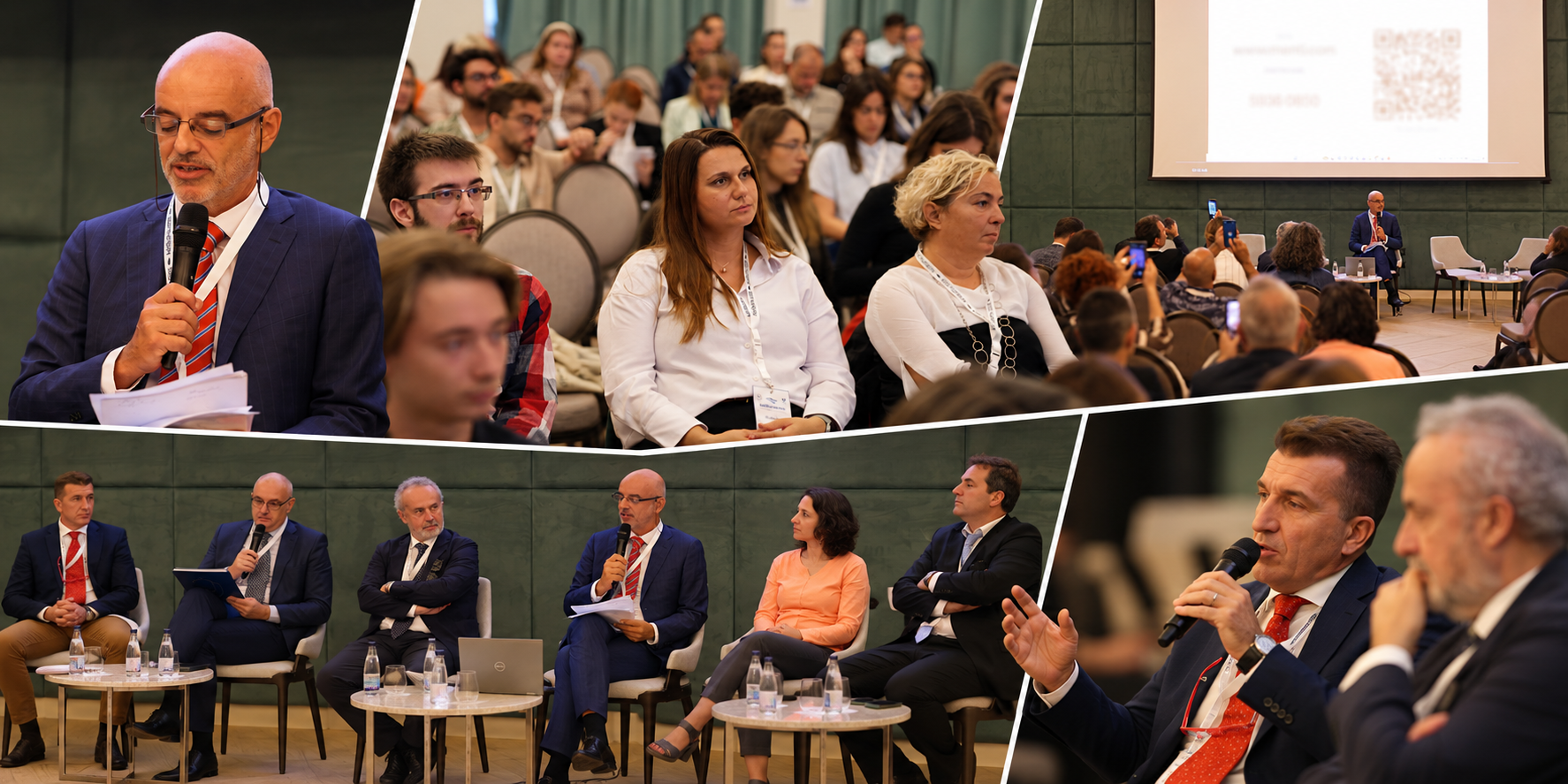
The High-Level Panel Discussion “Improving Skills Availability for the South Adriatic Blue Economy” was held on 23 September 2026 at the Hyatt Regency Kotor Bay Resort as part of the international AdriBioPro2026 Conference.
Moderated by Dr. Radoje Laušević, Institute of Marine Biology, University of Montenegro, the panel focused on one of the central challenges for the future of the regional blue economy: how to ensure the availability of qualified people with competences that match rapidly changing technological, environmental and labour-market needs.
The discussion was designed around the SA SKILLS approach of connecting labour-market needs, education and training, qualification frameworks, practical learning and cross-border cooperation, while linking project results with wider EU and macro-regional policy frameworks, particularly EUSAIR Pillar 1 – Blue Sustainable Economy.
From macro-regional policy to practical skills development
Seven complementary perspectives created a coherent discussion pathway from policy and Programme frameworks to education, networking, training instruments, qualifications and practical delivery.
Michael Chatziefstathiou, Coordinator of EUSAIR Pillar 1 – Blue Sustainable Economy, addressed the potential to capitalise SA SKILLS results at the wider Adriatic-Ionian level and connect blue skills development with broader EU innovation, employment and blue economy policies. The discussion highlighted the importance of ensuring that SKILLS tools, learning models and governance mechanisms can contribute beyond the lifetime of a single project.
Antonio Agrosi, representing the Puglia Region and the Interreg IPA South Adriatic Management Structure, focused on how cross-border cooperation can improve pathways towards sustainable employment and workforce mobility and how Programme investments in education, innovation and business development can be more closely connected with real labour-market demand.
Moving from policy to education, Prof. Danilo Nikolić, Faculty of Maritime Studies, University of Montenegro, presented the role of Higher Education Learning Modules in responding to identified skills gaps. Particular attention was given to practical, work-based and cross-border learning and to the need for higher education to become more flexible and closely connected to rapidly evolving blue economy sectors.
Building a connected blue economy ecosystem
Miško Rađenović, Director of the Adriatic Blue Growth Cluster, addressed the need for a permanent cross-border ecosystem capable of connecting companies, universities, research institutions, public authorities and training providers.
The Adriatic Blue Growth Cluster was presented as an instrument for transforming identified skills needs into opportunities for training, innovation, knowledge exchange, networking and capacity building, while supporting the long-term sustainability and capitalisation of SA SKILLS results.
Valeria Patruno, ARTI Puglia / Puglia Region, focused on the “on-demand voucher” scheme.
That instrument reflects the need for more flexible education and training mechanisms that can respond quickly when companies and workers identify emerging competence needs. This flexibility is particularly important for SMEs and blue economy sectors experiencing rapid technological and organisational change.
A common language for blue competences
An important part of the discussion concerned the need for greater transparency and comparability of qualifications and competences across the South Adriatic.
Dr Leida Matja, Deputy Chair of the Albanian Competition Authority, addressed the South Adriatic Blue Qualification Framework – SA BlueComp.
SA BlueComp is intended to provide a shared reference for understanding what people know and can do, what employers require, and how education and training can respond. A common framework can support more market-responsive education programmes, improve employers’ understanding of competences, help public authorities identify skills gaps and facilitate the visibility and transferability of professional competences across borders.
The proposed logic creates a practical bridge:
LABOUR-MARKET NEEDS → COMPETENCES → QUALIFICATIONS → EDUCATION & TRAINING → EMPLOYMENT.
From frameworks to practical delivery
The first round concluded with Dr Mirko Đurović, Director of the Institute of Marine Biology, University of Montenegro, presenting the role of the Blue Economy Training Centre in Kotor.
The Centre provides practical training infrastructure that can connect education and training with real workplaces, technologies, employers and blue economy challenges. Its potential extends to practical training, upskilling and reskilling, certification, lifelong learning and future cross-border training programmes.
Taken together, the seven interventions followed a clear progression:
Policy → Programme → Education → Ecosystem → Flexible instruments → Qualifications → Practical delivery.
This reflects the broader SA SKILLS ambition to move from individual activities towards a connected regional skills ecosystem.
Bringing the audience into the discussion
The panel format also included an interactive component using Mentimeter, allowing conference participants to contribute their perspectives on the future of blue economy skills.
Questions addressed issues such as:
the main obstacles to having the right blue economy skills available;
priority competences for future education and training;
the importance of cross-border cooperation;
which actors should take the strongest role in closing skills gaps;
and which single action could make the greatest difference over the next three years.
This interactive approach reinforced one of the central messages of the session: skills gaps are not simply an education problem, but a system challenge requiring coordinated action by education providers, employers, research institutions, public authorities and cross-border cooperation structures.
Towards a coherent South Adriatic blue skills ecosystem
Several strategic messages framed the conclusions of the panel.
Education and training systems need to become more flexible, allowing faster responses to technological change and emerging labour-market needs. Practical and work-based learning must be strengthened. Competences need to become more transparent and comparable across borders. And cooperation among education, research, business and public institutions must become a permanent feature of the regional blue economy ecosystem.
The panel also underlined the importance of looking beyond individual projects and capitalising SA SKILLS results through EUSAIR, Interreg, higher education, the Adriatic Blue Growth Cluster, flexible training instruments, SA BlueComp and the Blue Economy Training Centre.
The overall message can be summarised in one sentence:
A competitive South Adriatic blue economy requires not only the right skills, but a connected system capable of identifying, developing, recognising and continuously updating those skills across borders.